

March, 20XX
I’m scared.
A downturn like I’ve never seen before. I just watched a 20% drop in what feels like the blink of an eye. The strongest indexes are being sold off like the world is ending, and everywhere I turn for news I’m being told it’s the beginning of the end. The fear isn’t just in my portfolio — it’s in my chest. I feel it in every aspect of my life.
The macro data is mixed, with more bad than good. There’s no clean decision to make, and every day brings a headline worse than the last.
True confession: I never wrote that before just now, and the date is vague for a reason — not because I don’t remember.
Because depending on how old you are, how long you’ve been investing, and how active you are in your portfolio, you just read that and associated it with a feeling you’ve had. A 20% downturn in March, 20XX could be any of the following:
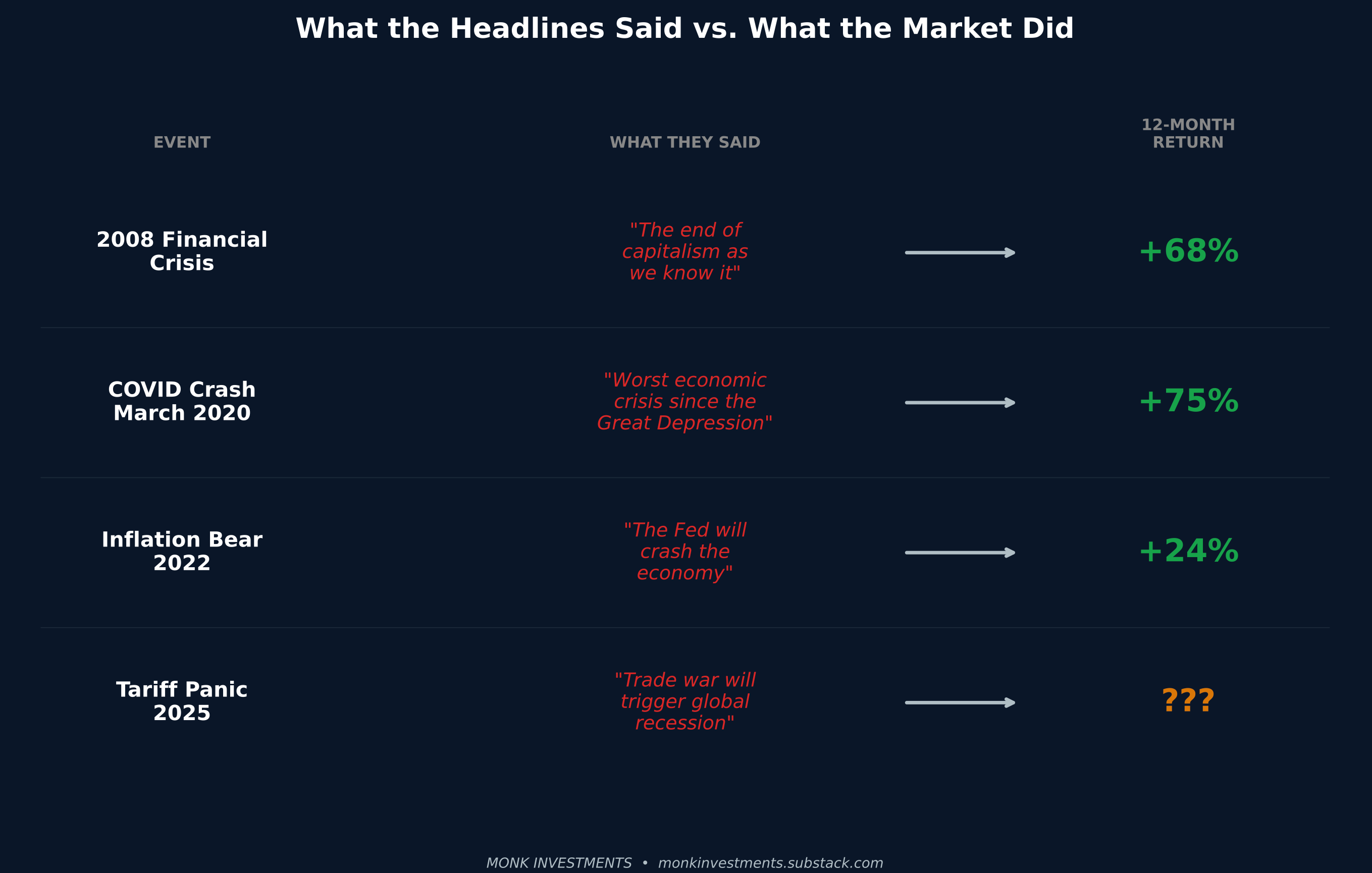
2008 Crash
COVID 2020
Inflation Hike 2022
Tariff Fiasco 2025
Four completely different events. The same fear every single time.
Investors are united by panic — but the majority default to selling instead of buying.
We’re going to fix that.
The Worst Strategy in Investing
Panic selling. It’s the art — if you want to call it that — of selling your positions at the bottom because emotions took over. You lock in real losses for the temporary feeling of safety, convincing yourself it could go lower. Then comes the rebound, as it almost always does, and the safety turns into regret. Now you’re buying back into the same position at a higher price just to not miss further gains.
TL;DR — Ever heard of “buy low, sell high”? This is the exact opposite.
The urge to sell everything when it’s red is the definition of market propaganda working on you. Think about it: buying an actively depreciating car is considered a sign of success nowadays (as correctly pointed out by Hayes Carrera ). If your house were to dip 30% in value, the thought of selling it wouldn’t even cross your mind. I could go on listing assets people hold through downturns without a second thought — except for one: stocks.
The stock market is the only place where everything going on sale makes people want to leave the store.
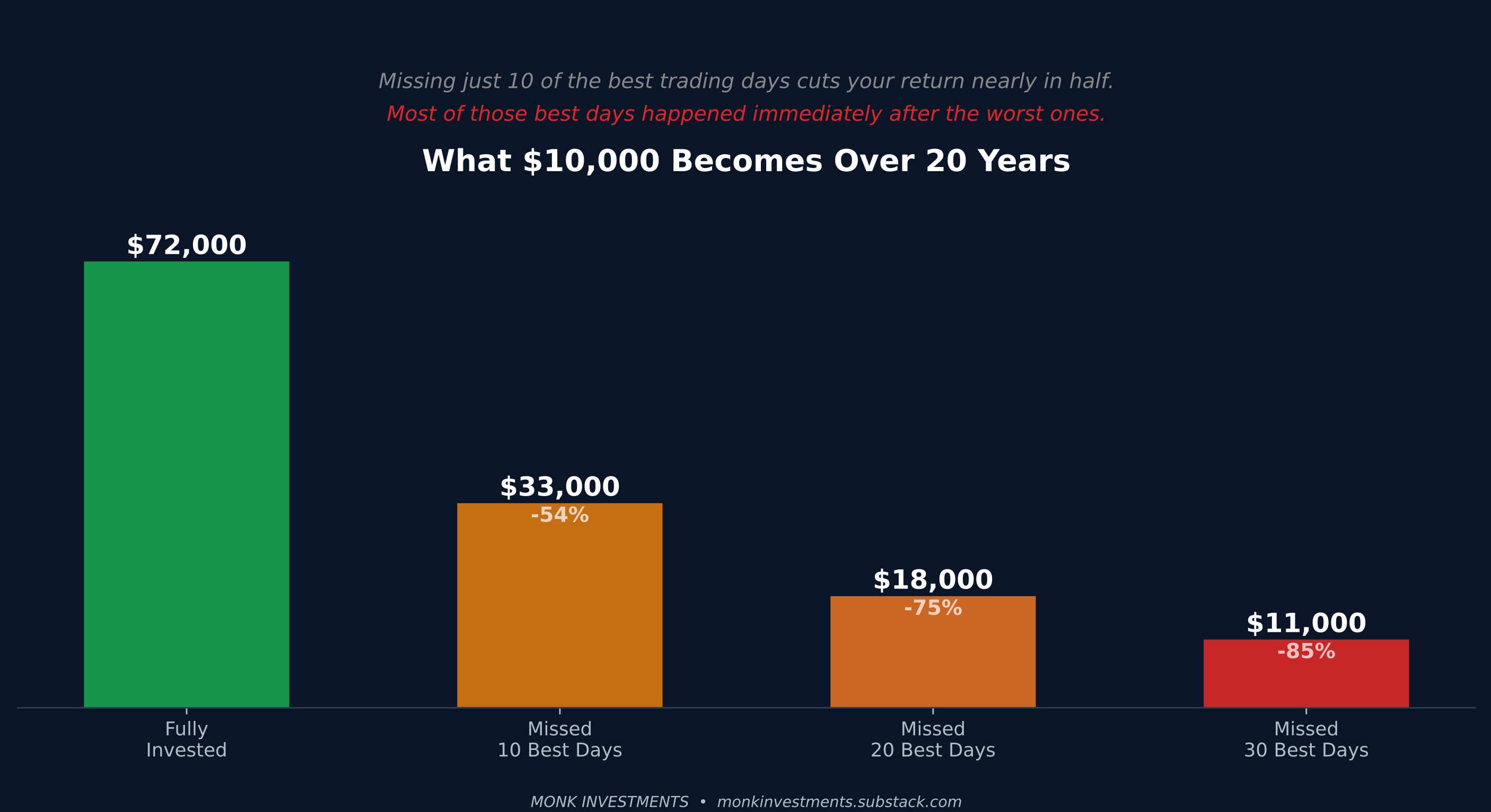
Studies show that missing just the 10 best trading days in a 20-year period slashes your total return nearly in half. And here’s the part most people miss: the majority of those best days happened immediately after the worst ones. The biggest green days come right after the biggest red days — and if you sold during the red, you weren’t there for the green.
The urge to sell everything in a downturn is a common experience for every investor. It’s also the most expensive mistake most of them will ever make.
Make This Time Different
Let’s audit the current economic situation:
Historically high tariffs
Rumors of war
Recession whispers
AI bubble fears
All of these are real threats, and each one creates genuine uncertainty. I’m not here to dismiss any of them. But here’s what the market is actually doing: pricing itself as if the worst-case scenario for all four happened simultaneously. Fear moves the market faster than reality ever could — that’s why dips are sharp and violent while rallies seem to sneak in unnoticed.
Most investors think the market waits for good news before it rebounds. It doesn’t. The market begins its rally when things go from “dumpster fire” to “slightly less bad.” You don’t need an all-clear signal. By the time you get one, the move already happened.
I don’t have a crystal ball, and I’m not going to pretend I had a Michael Burry moment to earn your trust. But allow me to show you that the market’s own history agrees with my logic.
Be Smart, Not Reckless
Putting everything into stocks tomorrow could work out. But so could putting everything on black. Here's a framework that will actually make you money.
Don’t time the bottom, you won’t. You won't. Maybe the market gives you one lucky call — the first one's always free. Instead, spread your buying over weeks and months. Dollar-cost averaging means if the market drops further, your remaining cash is ammo, not a homemade bomb.
Buy quality, not hype. During inflation, analysts talked about the first services customers would cut to save money. Apply that same filter to your stocks. If a company's product is the first thing people cancel in a recession, it's not the name you want to be holding. In times of panic, buying speculative stocks or "the next Nvidia" penny stocks just lets you lose money faster.
Have a plan. Easier said than done — I guarantee fewer than 30% of people reading this right now keep a journal of their investments. But this is what separates run-of-the-mill investors from extremely profitable ones. Know what you own, know why you own it, and know when you'd get out.
Alway keep cash in reserve. Ties back to point one: cash is ammo, not what blows up your account. If things get worse, the investor who kept cash on the side gets an even lower entry price. The investor who went all in at once just takes a bigger hit and watches.
This isn't ignoring risk. This is facing it head-on and profiting from it smartly. Risk is a byproduct of fear, and fear is what makes investors rich.
Every person who has bought during a market panic and held for a minimum of five years made money. Prove me wrong.
The hardest part of becoming a profitable investor isn’t the analysis — with the internet, that’s the easy part now. It’s the psychology. It’s buying when social media, the news, and every other Substack writer is telling you not to.
Buy when there's blood in the streets, even if the blood is your own
- Baron Rothschild
One of my favorite quotes along these lines is, “History does not repeat nor rhyme. It instructs.”
That's Tim Snyder, in On Tyranny. Fantastic book for those interested in the downfall of liberalism in Germany, Italy, and Russia in the 20th century.
But just as in politics, we can apply the same thinking to markets. No, this shock won't look like the 1970s—we were beholden to foreign oil supply in the 70s. History doesn't know about the shale in West Texas, but we do, so we can let it instruct us on what comes next. We know what to look out for (people are generally misusing "stagflation," but the lesson was clearly learned by some of us), and what to do next.
Markets are always forward-looking, and eventually, they will start to look beyond the consequences of the current situation in Iran.
You'd like this Schwab note that hit my desk the other day:
https://www.schwab.com/learn/story/ups-and-downs-stock-market-volatility
Cheers, Nate!