

“Google is planning to spend more than double in CapEx over the next 5 years than they have in the past 2 decades.”
I’ve seen this headline plastered across finance news and Substack for weeks. And if you don’t know what “capital expenditure” means, it sounds terrifying—especially if you own Google stock.
All you’re left with is some massive number, a vague sense of dread, and questions: Is this bad? Should I sell? What are they even spending it on?
Here’s the thing: CapEx headlines are designed to grab attention, not give you clarity. And when earnings season hits, you’ll see dozens more just like it.
So let’s clear the air. By the end of this breakdown, you’ll know exactly what capital expenditure is, why companies spend it, and—most importantly—how to tell if it’s a red flag or a smart investment in the future.
No jargon. No finance-bro nonsense. Just the truth about where your money is going when you invest in a company. Let’s dive in.
What IS Capital Expenditure? (The Basics)
Capital expenditure (CapEx) is money a company spends to buy or upgrade assets that last for years.
Think buildings, factories, equipment, or—in Google’s case—massive data centers to power their AI models.
Here’s the key difference: CapEx is an investment. Operating expenses are just the cost of keeping the lights on.
Example:
Paying rent every month? That’s an operating expense. You pay it, it’s gone, and next month you owe again.
Buying the building outright? That’s CapEx. You own it. It creates value for years. It’s an asset on the balance sheet.
Same goes for everything else:
Leasing a delivery truck = operating expense
Buying a fleet of trucks = CapEx
Paying for cloud storage monthly = operating expense
Building your own data center = CapEx
The bottom line: CapEx is about owning things that generate value long-term. It’s not money disappearing—it’s money being put to work.
Why Should Investors Care? What They Call The “So What” Factor
At first glance, CapEx seems pretty straightforward—just companies buying stuff they need to run the business. So why all the dramatic headlines?
Because high CapEx is a bet on the future. And not all bets pay off.
When a company like Google announces they’re doubling their CapEx spending, they’re essentially saying: “We’re pouring billions into something we think will make us money down the road… but it’s not guaranteed.”
For investors, that’s nerve-racking. You’re watching cash leave the company now in hopes it generates returns later. And if it doesn’t? That’s billions down the drain.
But Here’s the Catch: Not All CapEx Is Created Equal
Some industries require high CapEx just to survive.
Oil and gas companies need refineries
Car manufacturers need factories
Airlines need planes
For these businesses, heavy CapEx spending is normal. It’s the cost of doing business.
But when a software company suddenly starts spending like a manufacturing giant? That raises eyebrows.
What Really Makes Investors Nervous
It’s not just the dollar amount. It’s what CapEx does to free cash flow (FCF)—the money left over for dividends, stock buybacks, or paying down debt.
*Psst! Learn more about free-cash-flow and other terms Here!
When CapEx eats into this cash cushion, investors get anxious. Because now the company has less flexibility, less room for error, and less cash to return to you.
The question every investor should ask:
“Is this CapEx spending going to generate enough future revenue to justify eating into our safety net?”
Why Everyone Can’t Stop Saying “CapEx” | The AI Arms Race
Remember that Google headline from the intro? The one about spending more in the next 5 years than they did in the past 20?
Let’s talk about why that number—and dozens of headlines just like it—have taken over finance news.
The Numbers Are Bonkers
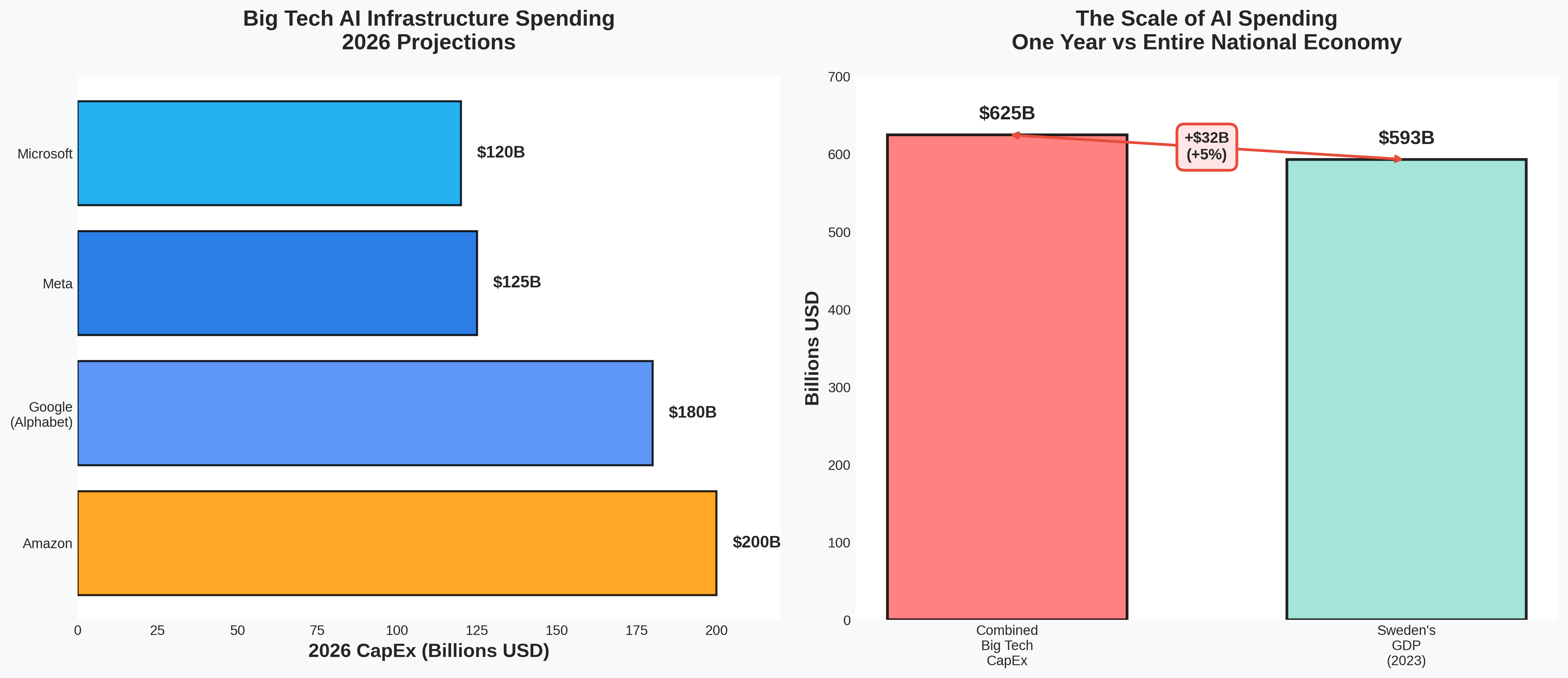
Amazon, Google, Microsoft, and Meta—none of which are traditionally CapEx-heavy industries—are planning to spend over $650 billion in 2026 alone.
That’s more than the entire GDP of Sweden. In a single year.
Breaking it down:
Amazon: $200 billion
Google: $175–$185 billion
Meta: $115–$135 billion
Microsoft: $120+ billion
These aren’t estimates from analysts. These are the companies’ own projections.
This Isn’t Normal Business Spending—It’s a Poker Game
Here’s where it gets wild: these companies are actively outbidding each other.
Google announces $185 billion? Amazon immediately updates their guidance to $200 billion.
Meta goes to $135 billion? Microsoft isn’t far behind.
It’s like a high-stakes poker game where everyone’s confident they have the winning hand—so instead of calling, they just keep raising.
Why? They all want to dominate AI in different ways, but none of them want money to be the reason they fall behind.
The Gamble: Nobody Knows If This Will Pay Off
This isn’t like building a factory where you know exactly what you’ll produce and how much revenue it’ll generate.
These companies are betting on three massive assumptions:
AI demand will keep skyrocketing
Their infrastructure will generate massive future revenue
They won’t get left in the AI dust by competitors
Right now, those assumptions look solid. But here’s the catch: the future is still uncertain.
Some analysts project these companies’ free cash flow could drop by 90% in 2026 in a worst-case scenario.
Amazon’s FCF? Projected to go negative for the first time in years. Meaning they’ll be spending more cash than they’re bringing in.
That’s exactly why Amazon’s stock tanked after earnings. Investors did the math—and got nervous.
The Bottom Line: CapEx Isn’t Just a Line Item Anymore
Some call this visionary. Others call it reckless.
But one thing is clear: these companies aren’t treating CapEx as normal business spending. They’re treating it like life or death.
Because in the race for AI dominance, falling behind isn’t an option—even if it means burning through billions of dollars hoping it pays off later.
Conclusion
Capital expenditure shows you exactly where management is betting the company’s future.
And as an independent investor, your job isn’t to blindly trust those bets—it’s to decide whether you believe in them too.
Your CapEx Audit Checklist
Before you buy (or hold) any stock with major CapEx spending, ask yourself:
1. Do I actually believe in what they’re building?
Don’t just accept “AI is the future” because a CEO said so. Do you think their specific AI bet will pay off?
2. Can they realistically capitalize on this investment?
Spending billions is easy. Turning it into revenue? That’s the hard part. Does this company have a track record of executing?
3. What percentage of their free cash flow am I comfortable with them burning?
If they’re spending 90%+ of FCF on CapEx, that leaves almost nothing for you—no dividends, no buybacks, no safety net.
Don’t Get Swayed by the Noise
You wouldn’t invest in your brother-in-law’s sketchy business venture just because he sounds confident, right?
So don’t let headlines, analyst reports, or charismatic executives convince you to ignore red flags.
Big Tech might be making massive AI bets—and some will pay off spectacularly. But that doesn’t mean every company pouring money into CapEx deserves your trust.
You’re an Independent Investor—Act Like One
Do your own research. Set your own comfort levels. And remember: CapEx isn’t inherently good or bad. It’s a bet. And every bet has a risk.
Now go read that next Yahoo Finance article about Amazon’s CapEx with confidence—because you actually understand what’s at stake.