

“Blah, Blah, Blah—Bitcoin”
Bitcoin, created by an unknown person under the pseudonym Satoshi Nakamoto, has evolved from an experiment gone right, to one of the most valuable assets in the world. With a disgustingly large all-time gain, creating countless millionaires, lots of headlines surrounding it, controversial opinions, and a sprinkle of political influence it’s extremely difficult to understand Bitcoin in general, let alone whether it’s a good investment, how crypto is different from stocks, and what is supporting this seemingly sketchy ‘pool of money’.
Simply, I am going to lay out the facts about Bitcoin that make me bullish on it and leave it to your interpretation to invest in Bitcoin at your own risk.
Bitcoin’s Fundamentals
I use the term fundamentals quite often in my articles when I refer to the basic statistics of a business’ stock. However, Bitcoin isn’t a stock, rather more of a digital commodity (digital gold for example). Which, on the surface makes it seem like there’s no fundamentals to cover, just as what could be argued for gold investors. I assure you, reader, Bitcoin has fundamentals, they just differ from the usual basic business statistics stock investors breathe in like oxygen. Let’s review the available information for Bitcoin:
Scarcity and ‘Market Cap’: Only 21 million Bitcoin will ever exist, which creates a scarcity, similar to gold.
Decentralization: Unlike stocks or a flat currency, Bitcoin isn’t tied down to a single company or the government (despite what the media may say).
Transparent yet Secure: The “Blockchain”—a public digital ledger used to record crypto transactions—ensures open verification, so Bitcoin doesn’t require a balance sheet, can’t be manipulated, nor come with ‘hidden’ risks.
The Network Effect: The more Bitcoin is adopted amongst society, the more utility it has. It’s already used for transactions, payments, assets, etc. Who knows what it can grow to as more people adopt the idea?
The Case for Bitcoin’s Future
As the last bullet point suggests, Bitcoin unlocks more utility and potential as more people acquire it, pump the value, and adopt the idea. One could ask: “What has Bitcoin done utility wise since its inception and being adopted in society thus far?”.
Created digital payment that is quicker than debit or credit cards.
Fraud-less transactions as a recipient/sender wallet ID contains no personal information tied to any transactions.
Countless businesses adopting it as the preferred online currency, such as Namecheap and overstock.com.
I believe this is more than enough proof that Bitcoin’s utility is revolutionary this far. But I want to continue this trend into the future and communicate why Bitcoin is a great store of value on top of its technological innovation.
Like gold in the 1970’s, Bitcoin’s function isn’t only a vehicle for storing value, but it’s becoming an everyday utility more and more as time goes on. I believe Bitcoin is the only relevant digital asset in this time. It can be used as both: a reserve asset that companies like Tesla, MicroStrategy, and many financial institutions use; plus a way to pay your friend instantly who you lost a bet to.
You don’t see people walking around with ounces of gold when they are planning to pay for a big purchase, nor stacks of cash in duffle bags—that is, assuming you’re not a criminal—we all have credit cards and debit cards. While this in itself was revolutionary technology, look at the dying asset they are tied to: the United States Dollar. Don’t believe me that the USD is a dying currency? Let’s take a look.
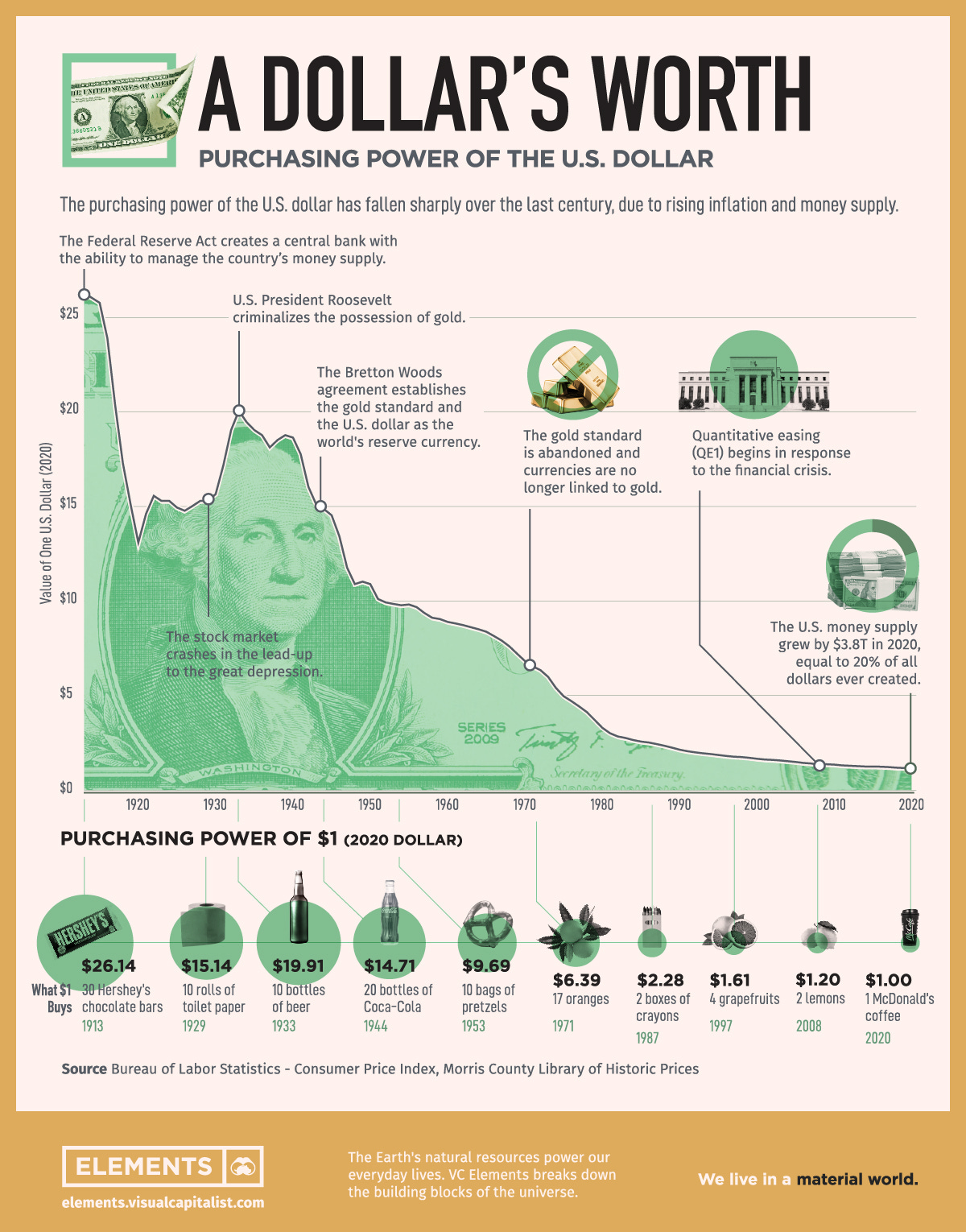
As you can see, since the criminalization of possessing gold, the USD has been on a linear decline since, due to inflation. Even when the gold standard was introduced, the USD was quickly losing value over the years.
With all this in mind, the main aspect of decentralization of Bitcoin seems like a no brainer if we want a currency that stays stable or even appreciates.
Bitcoin as an Equity, Not a Short Term Investment
The current and future utility of Bitcoin (the driver of its appreciation) is what makes true Bitcoin holders long-term believers, not short term day-traders of the coin. Bitcoin necessary adaptation reminds me of early internet stocks: volatile, not fully understood, controversial, but undoubtedly where the future is going. Therefore, those who understood the fundamentals reviewed earlier in the article before mass adoption gain the most out of anybody (such as the buyers when Bitcoin was literally pennies a coin!). So, by buying Bitcoin, you are hedging against inflation and monetary debasement, shifting from the systemic narrative assets, all while having it conveniently stored digitally and given/received instantly.
The lack of correlation Bitcoin has with other equities isn’t a defect but a strength. The ‘fundamentals’ of Bitcoin are the exact aspects that make gold, silver, and platinum so valuable, except Bitcoin is modern and not the same trading tool the Egyptians used. Bitcoin isn’t a scam, nor just another asset—it’s the evolution of money and I don’t want to be left behind; I hope you don’t either.
Hey Nate,
Nice article. I'm always interested in the maxi perspective.
I wanted to give you my coin-skeptic perspective—I speculate on crypto in the short term, but do not believe in the long-term narrative or economics of BTC as a real currency.
Consider that I am taking a broad view of the market here; in the short term, I do believe that the market has BTC priced right.
My primary thesis on BTC is that in its current form, the market treats it as a call option on risk behavior. We can see that in how BTC's price tends to react to changes in both liquidity velocity and junk credit spreads. I trade it and related firms (namely DATs) to that end, but I do not believe that BTC will ever truly be taken seriously as a currency.
---
On Scarcity and ‘Market Cap’
I think this works against BTC as a currency but for BTC as an equity-like asset. A commodity with a capped supply—or, in the case of my examples, inelastic supply—invites whales to become inordinately and permanently tyrannical within said commodity market. See Rockefeller with the oil market, the Hunt Brothers with the silver market, etc.
My argument against BTC to this end is that I don't believe a market with liquidity gatekeepers like Michael Saylor will be one that can garner and maintain the levels of trust needed to invite central banks and other serious players in currency markets, the thing that makes currencies actually viable as currencies. Without an expanding supply, early accumulators and those with enough fiat currency necessary to buy their way in (e.g., corporations), there is no way to compete. BTC is already a lost game with people like Saylor permanently in control.
On Decentralization
I think this threat is undersold here. BTC can become illegal to own, as it is for so many in the world already. Sure, one can try to skirt the law, but it always seems a futile endeavor to me to outsmart the U.S. government. If Uncle Sam decides to come for your BTC, your cold wallet won't be the ace in your sleeve that you believe it is.
And this doesn't necessarily just mean seizure a la the 1933 act for gold, but perhaps a left-leaning government in the future puts a tax on holdings of commodities or foreign currencies held by Americans (BTC is not domestic, per se; at best it's Japanese, at worst it's stateless) and demands a cut. Your asset sovereignty is only as good as your physical jurisdiction's. I can easily see a world where our government imposes digital asset taxes, and could even go as far as to tax their unrealized capital gains. "Bitcoin multi-millionaires" is a fine target for a left-populist politician in the U.S.
On Transparent yet Secure
So long as forks and rollbacks are possible, this is not as closed a book as it appears. Just because we haven't seen a fork or a rollback in some time doesn't mean it's not possible. Consider the 2010 and 2013 incidents where transactions were completely nullified.
Any entity that controls 51% of supply can create soft forks and alter the ledger at will. I believe that this is the core reason that large financial institutions have been clamoring to hoard physical Bitcoin and not paper, like they do with metals. They understand that having physical custody of the coins translates directly to power on the chain.
To this end, corporate entities already control nearly 20% of the total possible supply. I fear that once it crosses 51%, we will see a corporate coalition (think MSTR, COIN, BLK, Fidelity, various miners, and DATS, etc.) to ensure that voting on the chain is a right held by U.S. corporations and subsequently the government.
They are not going to stop accumulating supply until they have enough power. The Bitcoin total market cap is trivial to BlackRock at the end of the day; they are modulating their pace to control for risk, not because the end goal has changed.
On The Network Effect
I'm going to push back on the charge that adoption is happening in any serious capacity. The only adoption that is seriously catching on is with speculators; there are more speculators than ever.
Your example of Overstock.com is interesting here because it's been a terrible investment. Down 75% from the highs it reached in its merger and renaming to Beyond. It is currently below its 2002 IPO price. Being crypto-forward from the get-go did not help them. The tape is brutal to this co.
On Utility
My core argument against Bitcoin's utility as a currency is because it is too good at being a speculative vehicle. The maximalist mantra online has long been to get rid of as little BTC as possible, and experience with crypto maxis in my real life echoes this. Nobody wants to seriously get rid of their BTC; they'd rather lose their cash.
You make a great point for why people are happy to get rid of cash over assets (inflation). This is the argument against BTC as money. Nobody will want to get rid of their stash, as it stands to increasingly become more valuable as time goes on and more people cram into the capped supply.
Currently, ~70% of GDP is driven by consumption. A replacement of the dollar with a currency like Bitcoin at any scale stands to disrupt this tremendously. I very much doubt people will treat BTC the same way they do a fiat currency. We should very much prefer a world where they are separate so that we can transact in dollars and speculate on Bitcoin, not transact on Bitcoin and speculate on… I suppose I don't know what comes next if BTC ascends to currency-hood.
Of course, we also prefer low inflation, and your point is well-taken by the chart of the dollar's purchasing power decline. One thing to note is that the context for that spike in 1929-33, leading to the confiscation act, is the chart showing deflation.
Deflation is evidently a bad thing, and one none of us should hope for. Deflating prices, such as it was in the Great Depression, applied to wage labor. As labor supply increased due to the failing businesses caught up in the credit bubble, the price of labor fell. The stabilization of the dollar was necessary for the recovery from the Great Depression.
Imagine this BTC future: your job can afford to pay you fewer satoshis than they did last year, so your offer comes with a lower nominal pay. It may have actually increased in purchasing power terms, and you can buy more stuff, but you paid less in total currency units.
This is a reality that would make many unhappy.
On Quantum Risk
You didn't bring this up, but I thought I would since it's one of the pro-Bitcoin beliefs I hold.
I am not a believer that quantum computers will unexpectedly break AES-256. We will likely see it coming, and the chain can vote to move BTC's cryptographic hash to something quantum-resistant, which already exists in today's world. That vote is becoming easier and easier as time goes on, given the trends of rising corporate ownership who employ analysts to study this very topic.
---
Thanks for the time and discussion. Curious to hear what you think. Cheers!