

February 11, 2016
Global markets were plummeting — a weakening global economy was dragging down everything in sight. JPMorgan (JPM) shares were down nearly 20% and the S&P down more than 10% at their lows. Everyone was panicking. Everyone was selling.
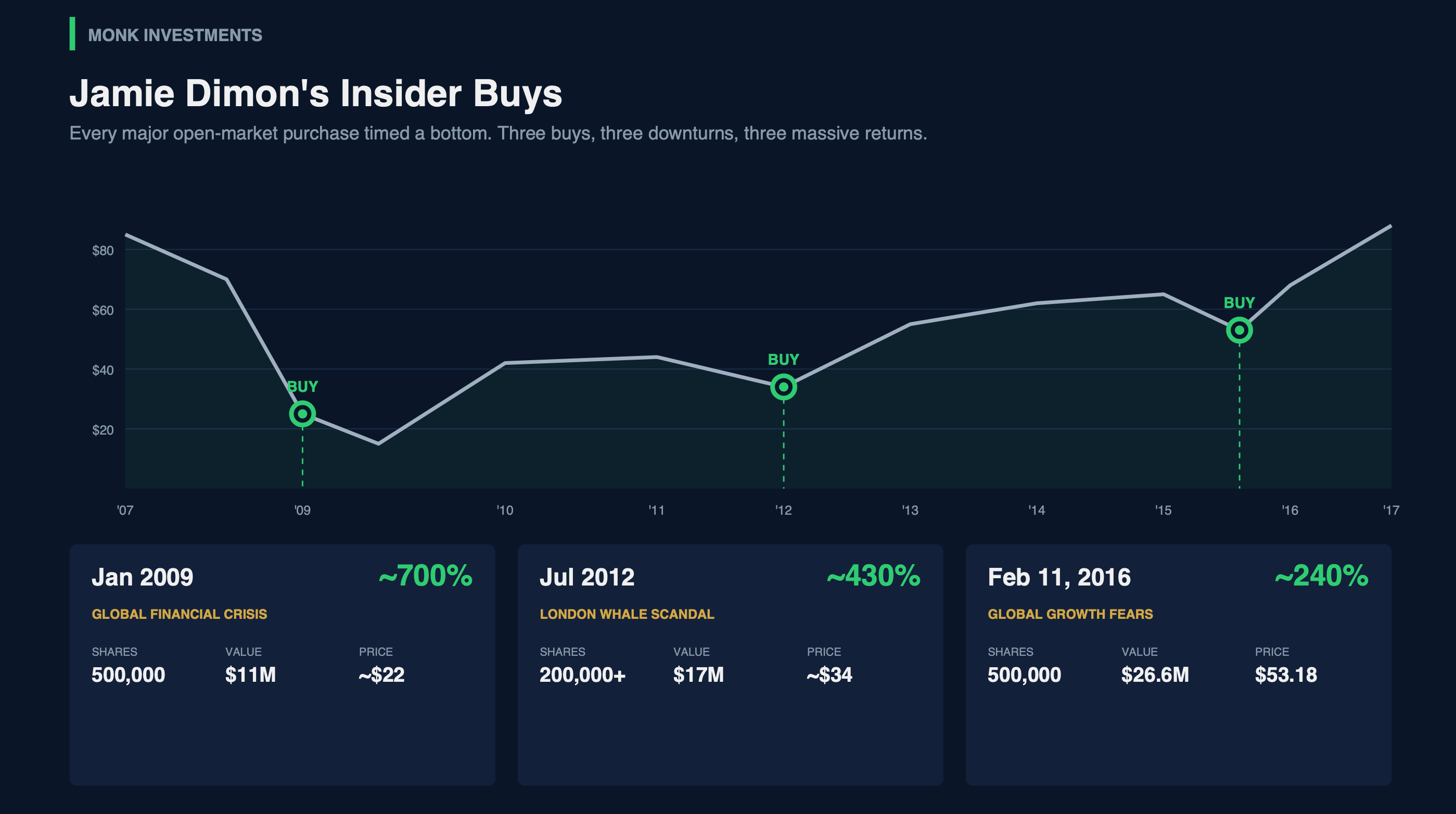
After the closing bell of this bloodbath of a day, Jamie Dimon (CEO of JPM) had some news to disclose: he had bought 500,000 shares of JPMorgan stock, worth ~$26 million at the time of purchase. For perspective, his entire 2015 compensation was $27 million. The man bet a full year's pay on his own company while everyone else ran for the exits.
February 11th turned out to be the lowest point both the S&P and JPM traded at for all of 2016. Many dubbed it "The Jamie Dimon Bottom." JPMorgan finished the year up 30%, and Dimon's shares returned 68.5%.
This wasn't the only time Dimon pulled this move. He bought 500,000 shares during the 2009 financial crisis (which have since returned nearly 700%), and made another buy during a downturn in 2012 (which returned over 430%).
Is Dimon more versed in the financial industry than the average investor? Likely. Can he keep his emotions in check during a market downturn? Of course. Does he have access to information that the common investor doesn't?
Intro
If the people running the company are betting their own money on their ability to steer their own ship, what do they know that you don't?
You probably know more about the business you work at than any outsider does. Yet when insiders buy their own stock, it's brushed off as normalcy — a "power move" to "inspire new investors." Allow me to make the case that insiders buying their own company's stock know something you don't.
This isn't insider trading. It's disclosed insider buying — and it's the most telling buy signal hiding in plain sight.
What Insider Buying Actually Is (yes, it’s legal)
First, let's define what makes an "insider" worth tracking. An insider is a stakeholder closer to the captain's quarters than you are: executives, directors, officers, or major shareholders (10%+).
Why must these people disclose when and where they buy stock? Because the SEC (Securities and Exchange Commission) says so — it's called Form 4, and it's public record.
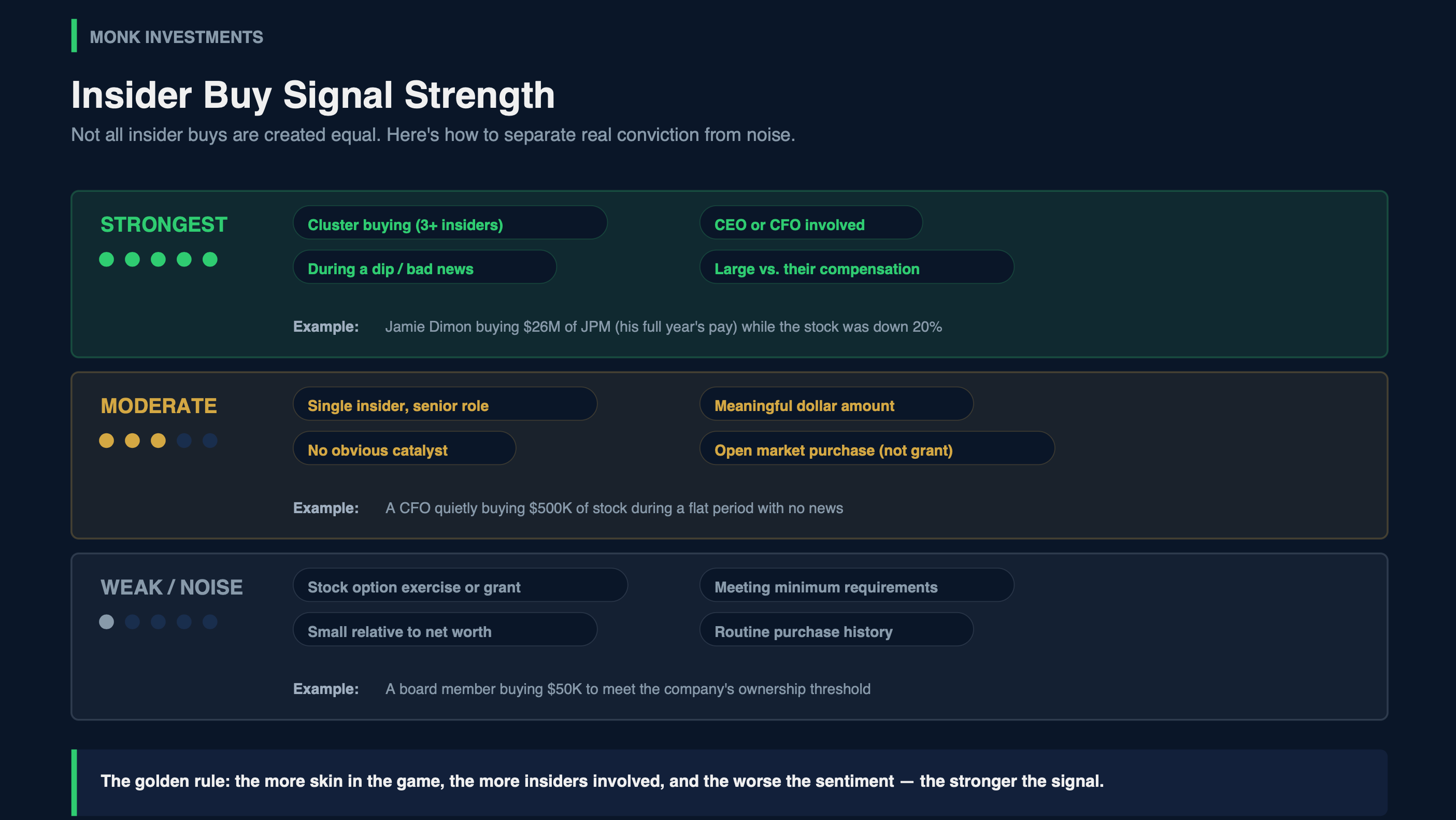
Insider buying is different from stock options or grants that a company offers. Those are employee compensation tools and have no correlation to the actual insider buying I'm referring to. Open market purchases from powerful people with skin in the game — that's meaningful information. Stock options and grants are just noise.
Finally, I'm focused on buying, not selling, for a reason: there are countless reasons to sell a stock and we rarely know the "why" behind an insider's decision to sell. But there's only one reason to buy.
Insiders vs. Analyst Ratings
Many investors rely on analyst ratings for another “professional” perspective. The problem is that analysts are outsiders looking in. That stock they just told you will climb 60% this year? It’s one of dozens of reports on their desk. And like many things, analysts have strength in numbers — which cuts both ways. If 100 analysts cover a stock and only 2 rate it a sell, your view would be very distorted if the first report you opened happened to be one of those two.
Insider buying avoids these problems entirely. It’s stakeholders from within the business applying what they know about the company to the stock — where analysts have it the other way around. Quantifying the confidence of insiders vs. analysts is simple: who has more at stake? Analysts have their reputation, granted. But insiders are risking their personal wealth, banking on a return. I would rather bet alongside people who have skin in the game than trust a mandatory speculation report. These insiders have asymmetric information — they see the pipeline, the margins, the efficiency of the operation. They know better than anyone whether the business will output a return or not.
What to Look For, and Where to Find It
The thing about insider buying is that looks can be deceiving. If a billionaire CEO buys $1M worth of shares, you can see how a headline like that might swing the wrong perspective. That purchase is essentially no different than Jeff the janitor buying $100 of stock in the company he cleans floors for — relative to their wealth, neither is putting much on the line. Often, a director making $180K a year who buys $50K of shares tells a better story than any exec buying to “communicate stock confidence.” The size of the buy only matters relative to what they have to lose.
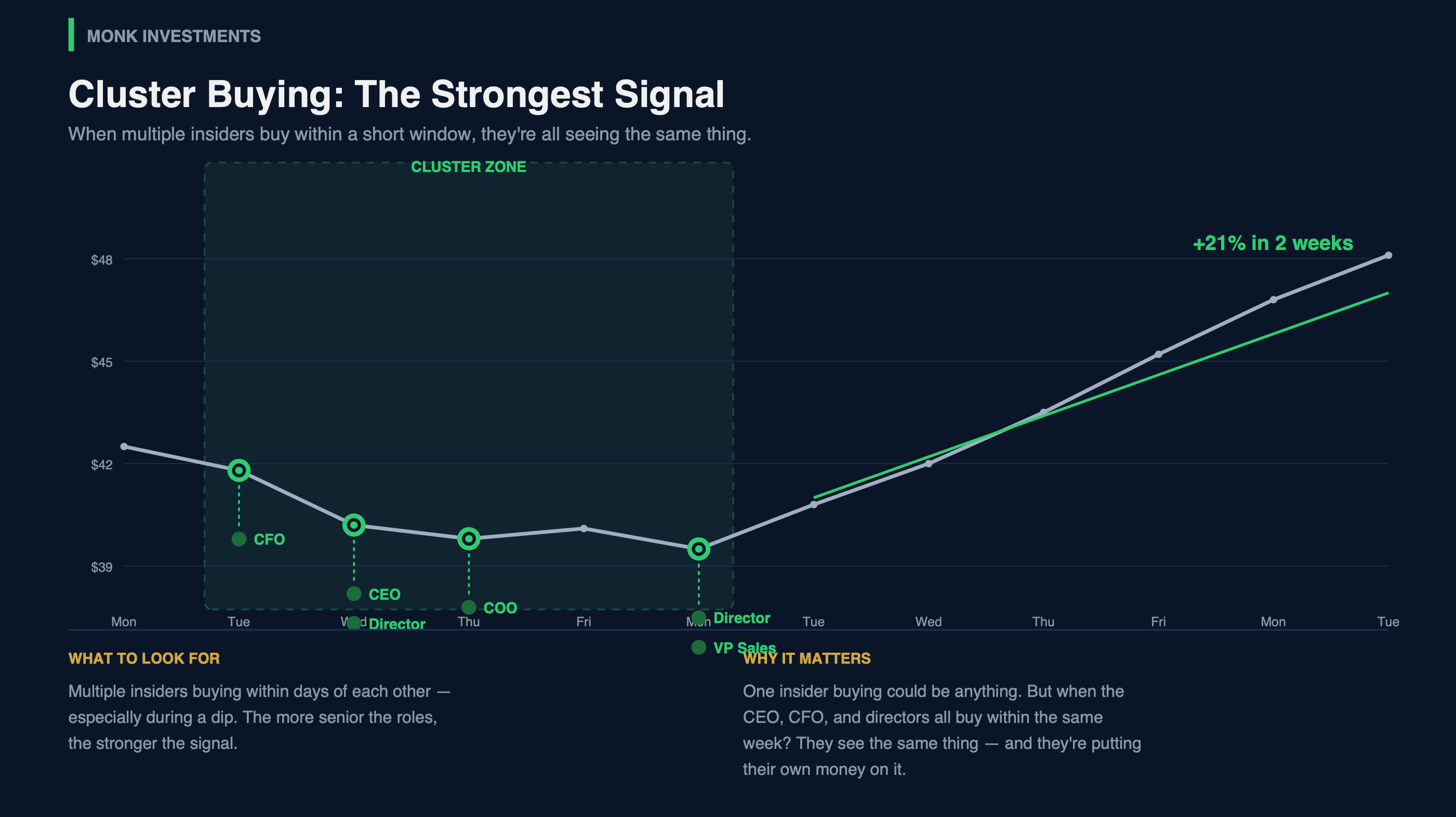
So to combat this, investors look for something called cluster buying. As the name suggests, cluster buying is when multiple insiders buy around the same time and price. A single purchase is a data point. A cluster is conviction — and it creates a far stronger signal than any outlier buy on its own.
Finding this data is easy and free. Here are some of the best places to look:
SEC EDGAR is the primary source — it’s free, straight from the SEC, and where all Form 4 filings live. If you want something more user-friendly, OpenInsider, Finviz, and Dataroma all pull from the same data but present it in cleaner, more digestible formats.
There are fancier tools out there with better visualizations and additional screening features, but they tend to come with a price tag. For what you need as a beginner, the free options more than get the job done.
Not a Sure Shot + Closing
While this may come as a surprise to some, these insiders are just as human as us. They can be wrong and it’s not uncommon for their financial judgement to be driven by their own company bias. Moreover, some companies have very little insider activity or mistime their buys heavily. Insider buying tracking is a great tool to have alongside fundamentals and other analysis, but can be catastrophic if looked at on its own.
That being said, insider buying is often more timely than any technical indicator can ever get it. Remember… outsiders looking in vs. insiders looking out.