

Here's a feeling you might have right now and not say out loud. You open your brokerage app. The S&P 500 is sitting about 1% under its all-time high, and a few taps away, the U.S. government will pay you roughly 5% a year to lend it money for ten years.[1][2]
So why put up with the stomach drops of the stock market when Uncle Sam will pay you to sit still?
It's a fair question. It's also the oldest question in investing, and it has a name: the risk-return tradeoff. I wrote about it back in January in Risk vs. Reward — the safer an investment, the lower its expected return, and the riskier it is, the more it has to pay you for the trouble. A bond paying this much doesn't break that rule.
It raises the bar.
What Just Happened to the Boring Stuff
A Treasury is a loan to the U.S. government. The yield is the yearly return you lock in if you buy it today and hold it until it matures.
I've been investing since I was 12. In that whole time, the ten-year Treasury never closed at 5% or higher — the last time had been 2007. Then it did in September, and on Oct. 5 it hit 5.31%, its highest close since 2002.[3]
Boring finally started paying.
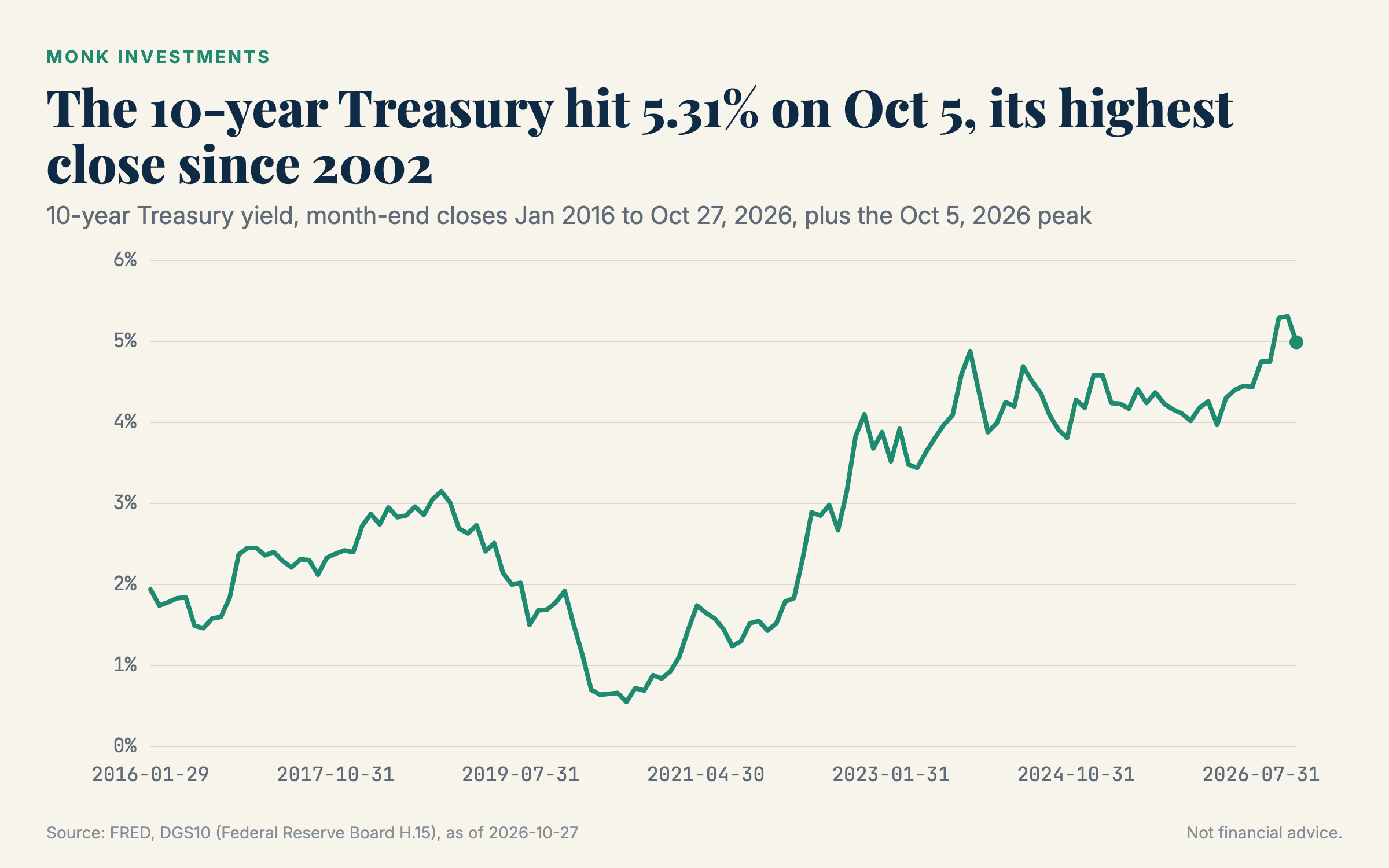
The Federal Reserve, the central bank that sets short-term interest rates, raised its target range in September to 3.75%–4%.[5] On Oct. 28 it held there, but the vote was 10–2, and both dissenters wanted another quarter-point hike. The official statement puts it plainly: "Inflation remains elevated."[4] If you want the long version of why the Fed moves stocks, here's my explainer.
Why should a stock investor care about a bond? Think of it like two job offers. If a stable, boring company offers you a solid salary and almost no chance of getting laid off, a startup has to offer a lot more — equity, upside, a bigger check — to get you to jump. The ten-year Treasury is the boring company. When it pays more, every riskier investment has to make a better case for itself.
TL;DR — When safe money pays more, stocks have to earn their seat.
Do Stocks Still Earn Their Seat?
Here's one rough way to compare them. The S&P 500's forward P/E, the price you pay for each dollar of profit companies are expected to earn over the next 12 months, was 18.7 as of Oct. 23, according to FactSet.[6] Flip that upside down and you get the earnings yield: about 5.35%. In plain English, for every $100 you put into the index, the companies inside it are expected to earn about $5.35 over the next year.
The 10-year Treasury closed at 5.00% that same day.[7] That's a gap of about a third of a percentage point. On paper, stocks are barely out-earning the bond.
But that comparison hides the most important difference. A bond's interest is fixed — it's written into the contract and never grows. A company's profits can. FactSet puts third-quarter earnings growth for the S&P 500 at 29.5% from a year earlier so far, blending the results already reported with estimates for the companies that haven't reported yet, and analysts expect 33.1% growth for all of 2026.[6] Profits can also shrink, and nobody writes that into a contract either.
The bond's number is a promise. The stock's number is a starting point.
Time Is the Tiebreaker
Back in January, Rule 1 was that your time horizon changes your gains. Here's the data behind it, using NYU professor Aswath Damodaran's annual return figures going back to 1928. In any single calendar year, the S&P 500 (dividends included) beat the 10-year Treasury 64% of the time — 63 out of 98 years. Stretch that to 10-year periods and stocks won 85% of the time. Over 20-year periods, they won 78 out of 79.[8]
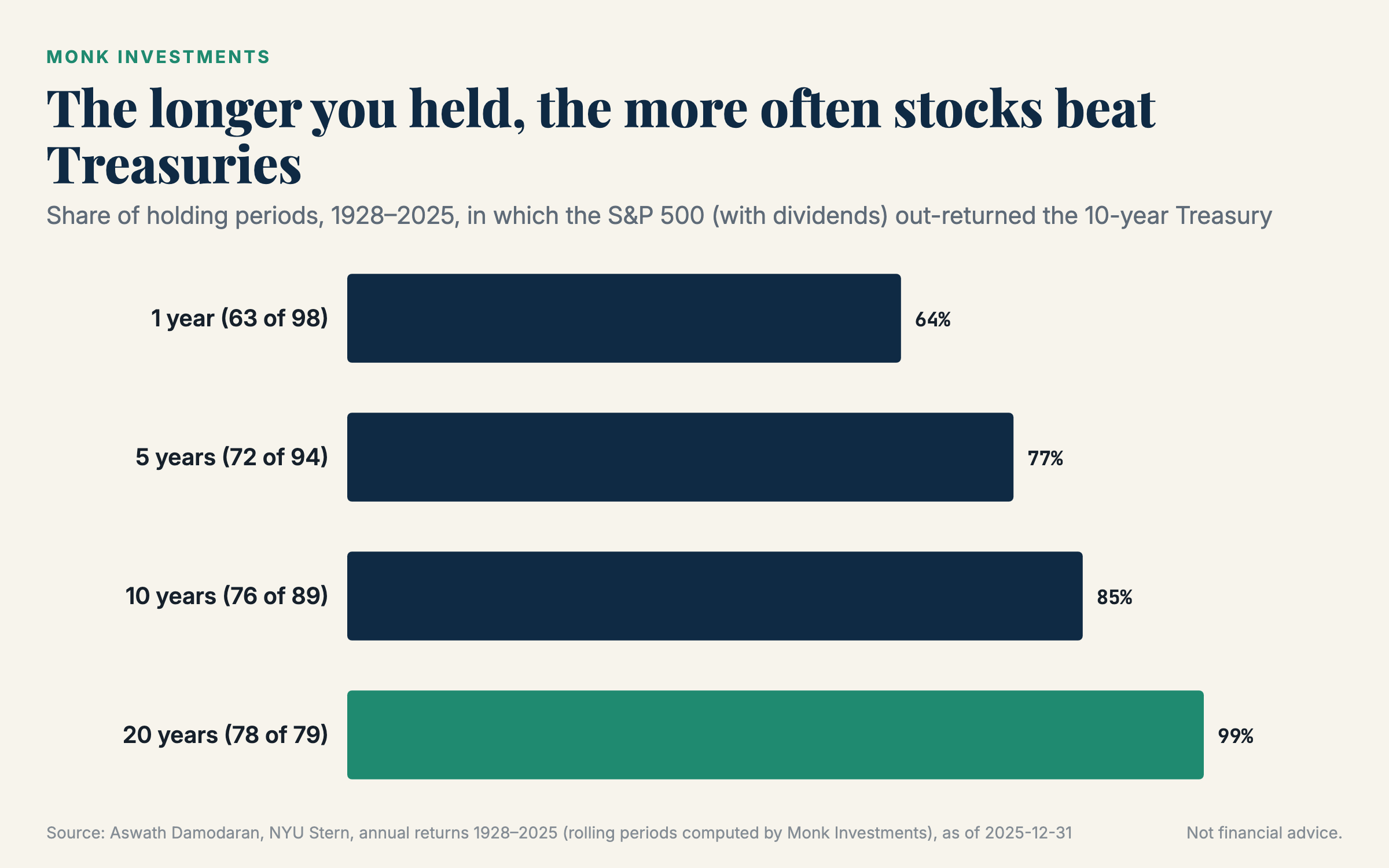
Now the fine print. Those periods overlap, so they aren't 79 separate experiments — it's one country's history, and that country had a very good century. The single 20-year stretch where bonds won started in 1929, right before the Great Depression. You don't have to go back that far to get burned, either: from 1999 through 2008, the S&P 500 lost about 1.4% a year while the 10-year Treasury earned about 6.6% a year.[8] A full decade of taking more risk for less money.
Yikes.
Safe Doesn't Mean Painless
Bonds carry their own risk, and 2022 was the reminder. When rates jump, older bonds paying less interest become worth less if you have to sell them early — that's called interest-rate risk. In 2022 the S&P 500 fell about 18%, and the 10-year Treasury lost almost exactly as much, about 17.8%.[8] Hold a Treasury until it matures and you get the promised interest and your money back, but inflation can still quietly shrink what that money buys.
So the real question isn't stocks or bonds. It's when you need the money.
This Could Be Wrong If…
A few honest caveats. Expecting 33.1% earnings growth for the year is a high bar, and the biggest gains are coming from a handful of sectors — energy, technology, communication services and materials.[6] If those disappoint, the earnings yield shrinks and the math above gets worse for stocks. If inflation keeps running hot and yields climb back past this month's peak, stocks would have to work even harder to compete. And comparing an earnings yield to a bond yield is a rule of thumb, not a law — it puts a forecast next to a promise, and plenty of smart people think it oversimplifies.
How Much Risk Can You Actually Handle?
This is where January's lesson comes back. Neither the bond buyer nor the stock buyer is automatically doing it wrong. Money you'll need for a car, tuition or a down payment in the next few years has a real reason to sit somewhere boring, and money you won't touch for decades has history on its side in stocks, with every caveat above attached. The mistake is letting a headline — not your timeline — make the choice for you, or Googling "best stocks to buy 2026" at 1 a.m. because a bond yield made you nervous.
I'm not a licensed advisor, and none of this is personal advice. If you want the basics on how bonds work and what interest-rate risk actually means, the SEC's Investor.gov explains both in plain English.
Safe money is paying again. The question is whether your risk still is.
So tell me: how high would the ten-year have to go before you'd move money out of stocks? Drop your number in the comments.
Until next time — let's keep the stock market simplified.