

Picture last Thursday, Nov. 5. You open your brokerage app and it's red from top to bottom. The Dow is down 1,833 points. The Nasdaq is down 5.5%, its worst day since April 2025.[1]
Now picture a grocery store that same afternoon. Somebody is standing in the toothpaste aisle, comparing two tubes, with no idea anything happened.
That second scene is the whole lesson.
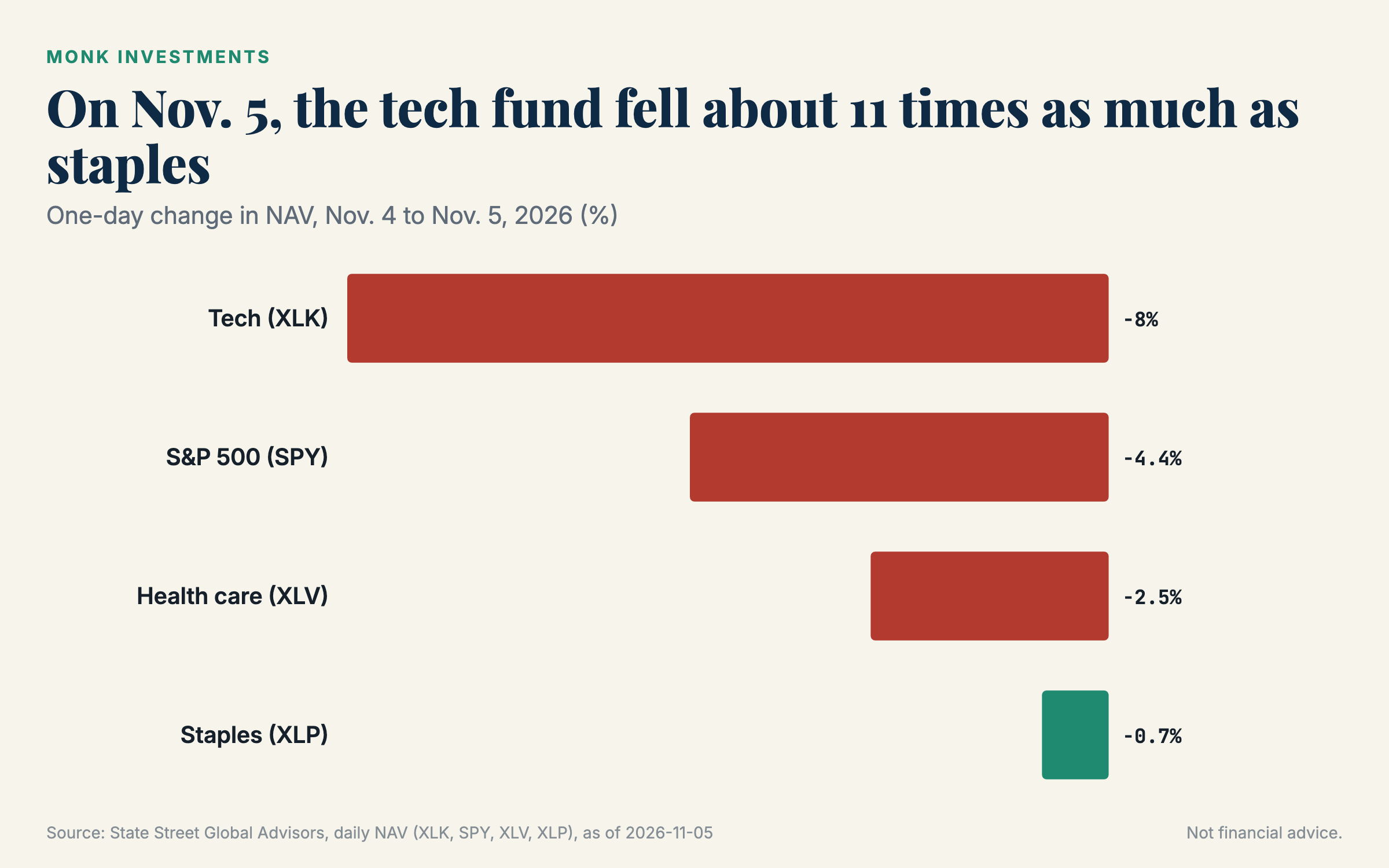
On the day tech fell, the fund that holds the biggest U.S. tech companies (ticker XLK) dropped 8.0%. The fund that holds the companies behind your toothpaste, groceries and paper towels (XLP) slipped 0.7%.[3] Same market, same day, wildly different outcomes. Nobody put their toothpaste back on the shelf because of a stock chart.
TL;DR — Tech fell. Toothpaste didn't. That isn't luck. It's what owning different kinds of businesses is supposed to do.
How We Got Here
The Nasdaq, the index packed with tech companies, set a record close on Oct. 6. By Thursday's close it sat 11.9% below that record.[2] That's what Wall Street calls a correction — a drop of 10% or more from the top.[8]
The trigger was election week. Investors started worrying that the results could slow down construction of the giant data centers AI runs on, and the chip companies that sell into those data centers took the worst of it. Nvidia fell 9% on Thursday. Broadcom fell 10%.[1]
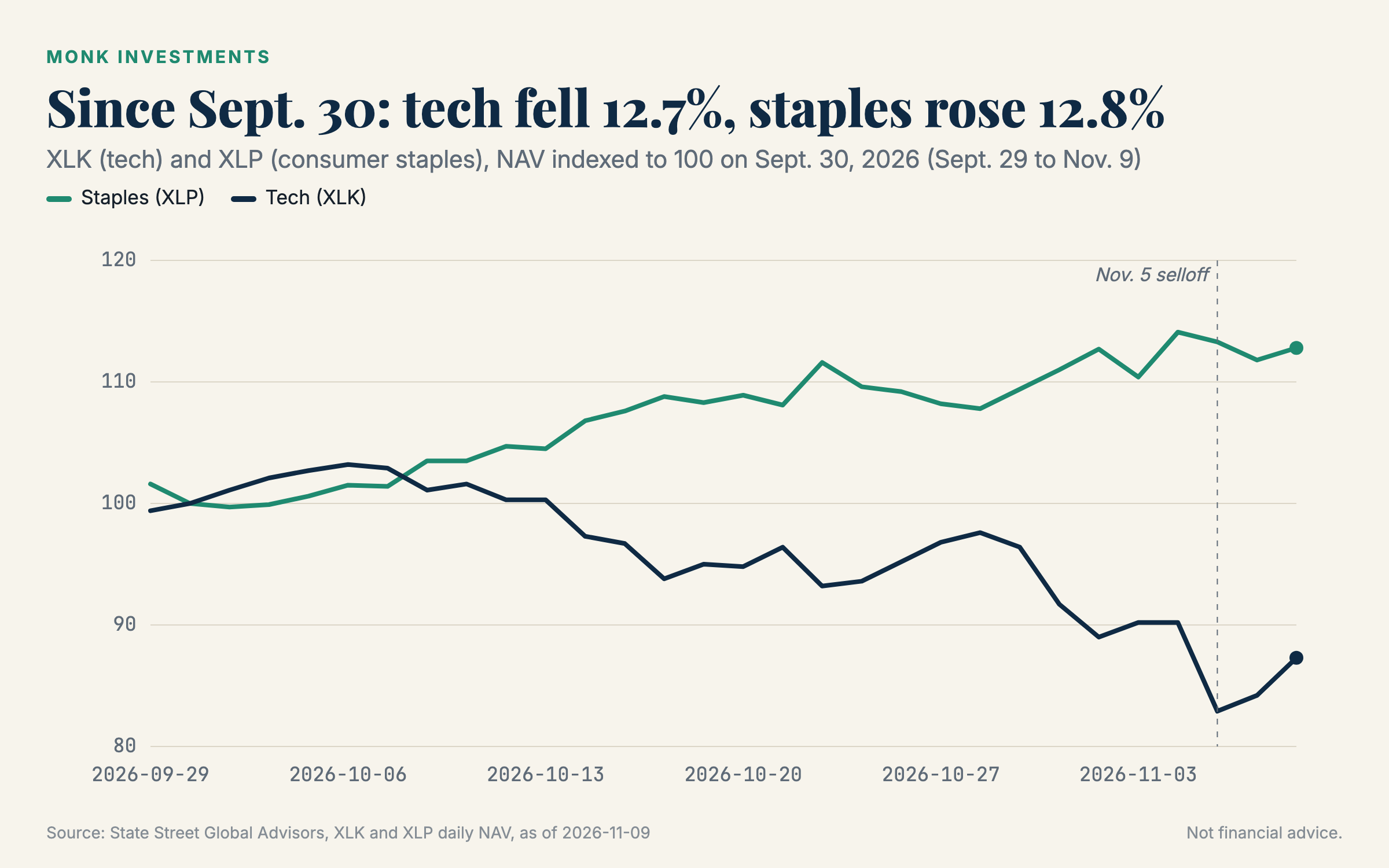
But this didn't start Thursday. Over October, XLK fell 8.3% while XLP rose 11.0%. By State Street's own daily numbers, that was the staples fund's best calendar month in the history it publishes, back to 2003.[3] Health care's fund, XLV, rose 9.9% the same month.[4]
The Question That Still Works: What Gets Canceled First?
Back in April, in Blood in the Streets, I laid out my Panic Buyer's Framework. Rule number two was simple: buy quality, not hype, and ask what people cancel first when money gets tight. Don't own a pile of that.
To be clear, this selloff isn't a recession. Nobody lost a paycheck because of Thursday. But the question still works, because it makes you look at how a business actually earns money instead of how its stock has been acting lately.
Toothpaste, dish soap and groceries are what people keep buying after everything else gets cut. Procter & Gamble, the company behind Crest and Tide, grew organic sales (sales growth without currency swings or acquisitions) 4% last quarter, and even its oral care business grew a little.[7] That's not exciting. It's steady. And steady is exactly what you want from the part of your portfolio that's supposed to hold up when the exciting part doesn't.
Your Index Fund Is More Tech Than You Think
Plenty of beginners own an S&P 500 index fund and assume that makes them diversified. Partly true — you own about 500 companies. But the fund weights each company by its size, so the biggest ones count the most. The largest holding carries more than a thousand times the weight of the smallest ones.[5]
As of Monday, Apple, Nvidia and Microsoft together made up 20.7% of the SPDR S&P 500 ETF (SPY). Its top 10 holdings were 37.3%. Colgate-Palmolive was 0.12%.[5] Put another way: for every $100 in that fund, about $20.71 sits in three tech giants and about 12 cents sits in Colgate.[5]
Owning hundreds of companies is not the same as owning hundreds of equal bets.
That's why a "diversified" account still dropped hard on Thursday. SPY fell 4.35% that day, about half as much as the tech fund and six times as much as the staples fund.[4][3]
Diversification is a spare tire. It's dead weight in your trunk ninety-nine days out of a hundred, and it's the only thing you care about on day one hundred. Thursday was day one hundred for a lot of people.
Don't Read This as "Sell Tech, Buy Toothpaste"
Here's where I'd push back on the crowd that suddenly loves boring stocks.
First, tech hasn't lost the year. Even after this drop, XLK was up 18.7% for 2026 through Monday, slightly ahead of XLP's 17.0%.[3] Someone who dumped all their tech in January to hide in staples would have nothing to show for it.
Second, the staples rally outran the businesses underneath it. P&G's earnings per share, the profit behind each share of stock, grew 1% last quarter, and the company still expects only 1% to 3% organic sales growth for the full year.[7] Meanwhile the staples fund jumped 11% in a single month.[3] That isn't toothpaste demand surging. That's scared money looking for a place to hide. A safe business can still be bought at an unsafe price.
Third, corrections tend to end, just not on anyone's schedule. CNBC looked at 10 earlier Nasdaq corrections over the past decade: on average, the index was up 9.41% three months after the bottom. The exception was 2022, when it lost another 18.3% over the next six months.[8] Ten episodes is not a sample size worth betting the farm on, and nobody knows yet whether Thursday was the bottom. The Nasdaq bounced on Monday and still closed 8.5% below its record.[2]
This whole take could age badly if the data center worries turn into real canceled orders and lower earnings for chip companies. Then it stops being a scare and becomes a repricing, and a tech-heavy portfolio has a bigger problem than one bad week.
Be Boring on Purpose
So what's the takeaway for a beginner? Not a trade. A check-up.
Look at what you own and ask the Panic Buyer question about each piece: if money got tight, would people cancel this first or last? If the honest answer is "first" for almost everything, your portfolio isn't diversified, no matter how many tickers are in it. That's true whether you own five stocks or one index fund.
Diversification won't make you rich faster. I said as much in The Power of Diversification. Its job is to make sure one bad Thursday doesn't talk you into something dumb on Friday. That beats any list you'll find Googling "best stocks to buy 2026."
In Pro this week, I'm running a full concentration check on the index funds beginners actually own: how much of each one rides on a handful of tech names, and how to read your own fund's holdings in a few minutes.
Tech fell. Toothpaste didn't. Own enough of both that a day like Thursday is something you can brush off.
Your turn: what's the most boring business you own, and why do you own it? Tell me in the comments.
Until next time — let's keep the stock market simplified.