

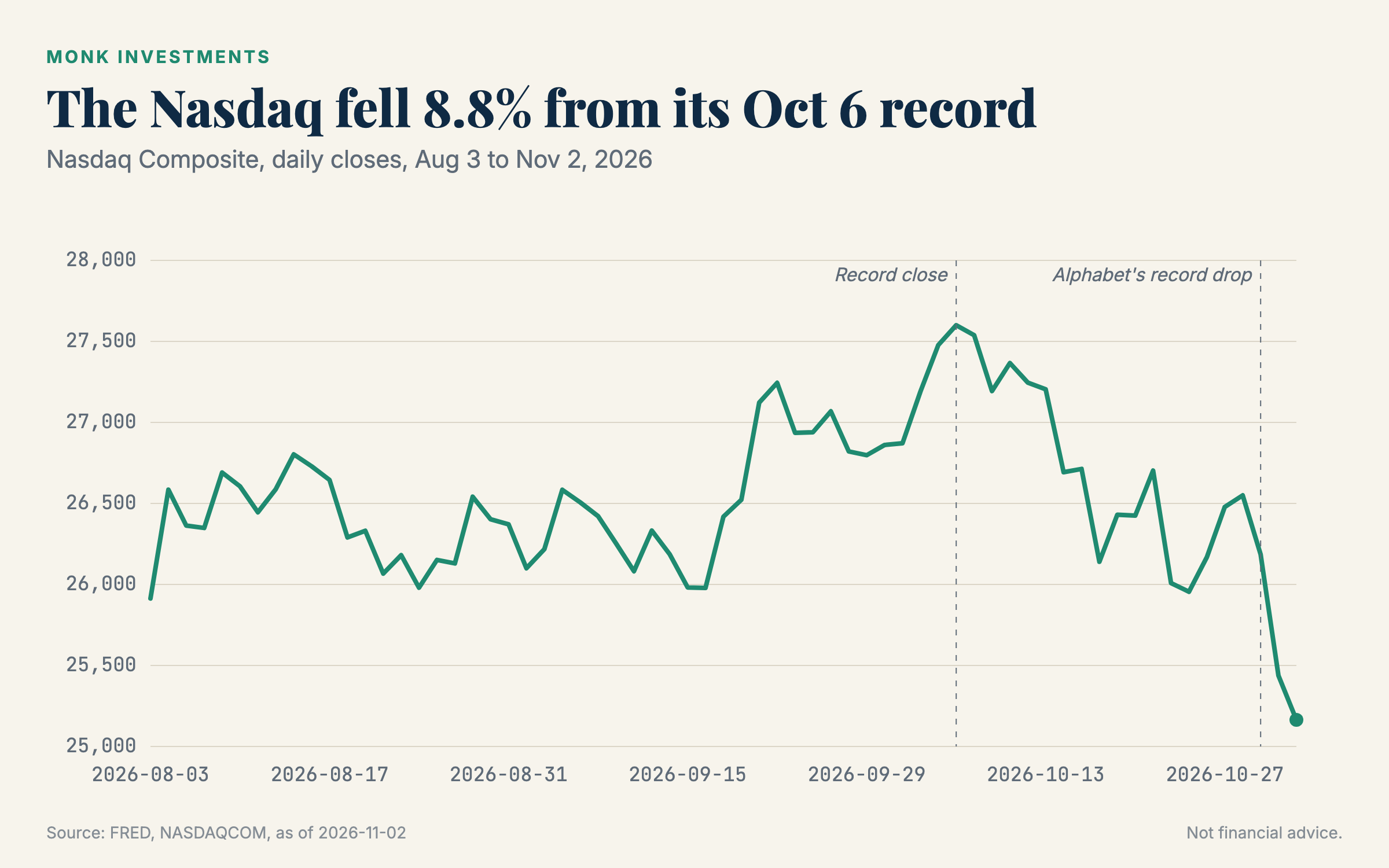
You didn't have to open your brokerage app last Friday to know how it went. A day after Alphabet, Google's parent company, had its worst day on record, down more than 12%, Intel dropped 29%. By the closing bell, the Nasdaq had wrapped up its worst month since March 2025.[1][2]
Then one word showed up everywhere at once: bubble.
Finance YouTube dusted off the big red CRASH thumbnails. Even OpenAI, the company behind ChatGPT, scaled back how much money it's trying to raise, from about $30 billion to up to $20 billion.[3] If you own an index fund, you felt some of it, even though you never bought a single "AI stock" on purpose.
Here's my problem with the question everyone is asking. "Is AI a bubble?" only gets answered after the fact. But there's a better question you can check yourself, today, for free: is the money behind this boom real, and who's paying the bill?
TL;DR — Stop asking whether it's a bubble. Start asking who's paying for it.
I've Been Here Before
Last December I wrote a Pro piece called Yes, There's an AI Bubble. No, It's Not About to Pop. My main argument was that the financials were real. The revenue side of that argument has held up. What I barely looked at was the cash side — and that's exactly where this quarter got ugly.
So instead of defending an old take, I'm running the check again from scratch, with my trend check from The Best Investment Advice Nobody Follows and one extra question from my CapEx explainer.
Question 1: Is Anybody Actually Making Money?
Yes. This is the part of the bubble story that doesn't fit.
Alphabet's cloud business, the part that rents out computing power and AI tools to other companies, more than doubled its revenue from a year earlier, to $30.7 billion in one quarter. It earned $11.1 billion in operating profit, up from $3.6 billion a year ago.[4] Amazon's cloud arm, AWS, grew 39% and earned $17.8 billion.[6] Microsoft's Azure grew 48%.[7] Zoom out to the whole S&P 500, and FactSet puts third-quarter earnings growth at 30.2%, with technology among the leaders.[9]
These aren't startups with a logo and a dream. Customers are paying real money for this stuff, right now.
Question 2: Is the Price Already Too High?
The quickest gauge is the forward P/E — how many dollars you pay for each dollar of profit companies are expected to earn over the next 12 months. For the S&P 500 it's 18.7, a bit below its five-year average of 19.8 and its ten-year average of 19.1.[9]
That's not what a mania usually looks like. But be honest about what it measures. It's the whole index, not just the AI names, and the "expected" part is doing heavy lifting: analysts are counting on 32.9% earnings growth this year.[9] If AI spending stops paying off, the E in that P/E shrinks, and a fair-looking price stops looking fair.
Question 3: Fad or Real Trend?
At the height of the GPU shortage, I hunted Micro Center for the last part of my PC build. The store had three in stock when I called, and I walked out with the last box, an Nvidia RTX 3080 Ti. On the drive home, my dad said: "If this thing is in this great of demand and in constant shortage, the company ought to be doing pretty well for themselves." Hours later, he bought Nvidia stock.
That's the trend test in one car ride: notice what people can't stop buying. Today the line out the door is for computing power. Alphabet says its Gemini app has reached one billion users, and its cloud revenue doubled.[4] Whatever this is, it isn't a fad.
But a real trend and a good investment aren't the same thing. Which brings me to the question the headlines skip.
The Question That Matters: Who's Paying the Bill?
CapEx — capital expenditure — is the money a company spends on long-lasting stuff like data centers and chips. Free cash flow is what's left of the cash the business brings in after paying for all of it.
Here's Alphabet. In the third quarter it brought in $42.3 billion of cash from operations and spent $51.4 billion on property and equipment, more than double the $24.0 billion it spent a year earlier. That left free cash flow at negative $9.1 billion, the second negative quarter in a row. It hasn't bought back a single share this year, after $39.8 billion of buybacks in the first nine months of 2025. Instead, it sold $12.4 billion of new stock and $28.7 billion of new bonds in the quarter.[4]
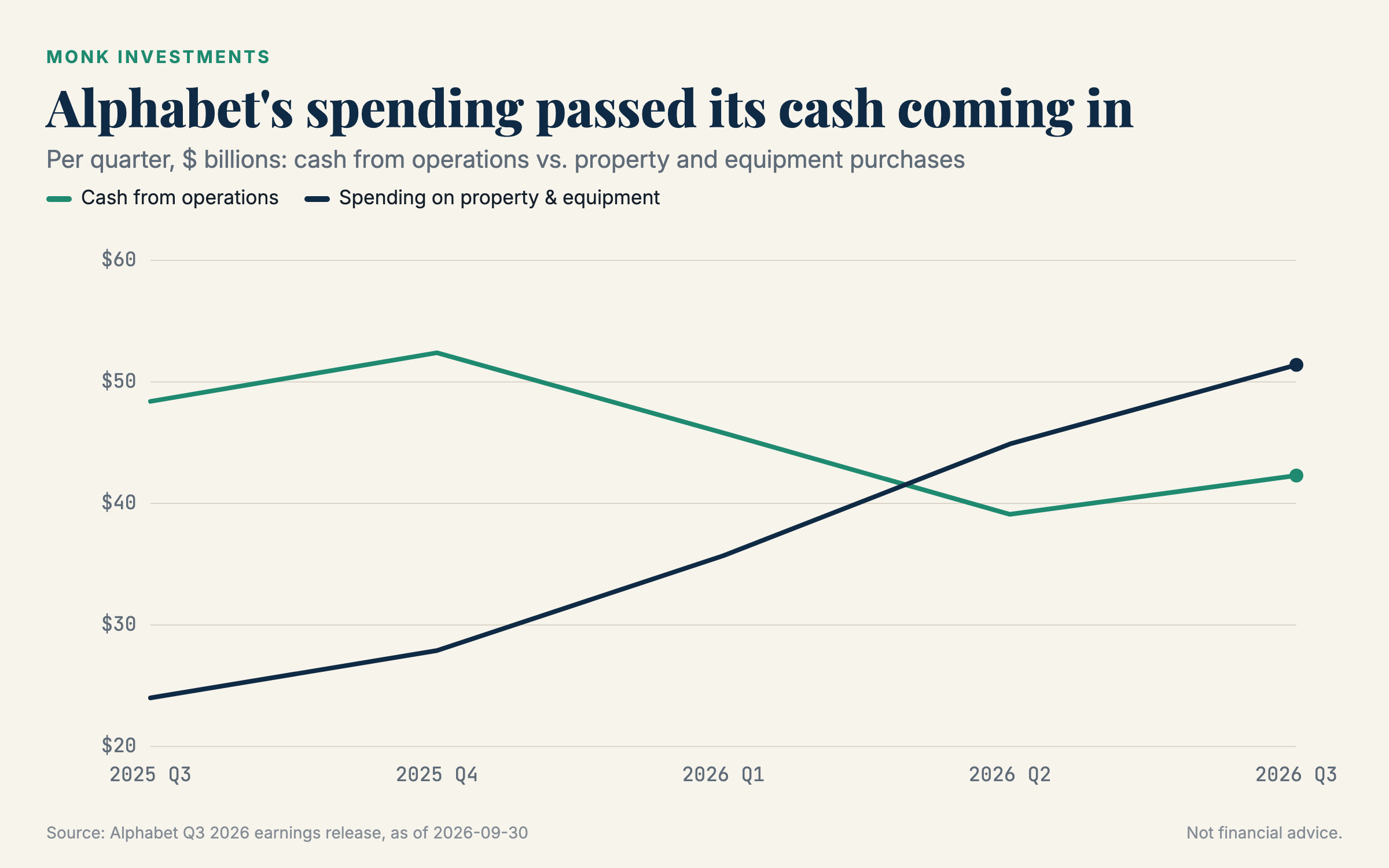
And it isn't slowing down. Alphabet expects to spend $195 billion to $205 billion this year, and its finance chief told analysts spending will rise significantly in 2027. Its long-term debt is $125.1 billion, up from $21.6 billion a year ago.[5]
Amazon is in the same spot. Over the past 12 months its free cash flow was negative $42.4 billion, compared with positive $14.8 billion a year earlier, and it still plans to spend about $220 billion this year.[6]
Microsoft is the counterexample. It's spending heavily too, but it still produced $18.6 billion of free cash flow last quarter, down 27% from a year ago, and it's still paying shareholders.[8][7]
Think of a barbecue joint with a line wrapped around the block. The owner decides to open five new locations at once and puts the construction on a credit card. The line is real. The brisket is real. But you'd want to know how fast those new places fill up before the card bill comes due.
That's the AI trade right now. The demand is real. The question is whether the spending is getting ahead of it.
So, Is It a Bubble?
My honest answer: the business looks real, and the financing is starting to look stretched. Bubbles tend to get blamed on hype, but hype alone doesn't sink a company. Running out of cash, or out of people willing to lend it more, does.
Here's what I'm watching. Every quarter, compare the cash a company brings in with what it spends on data centers. If that gap keeps widening while cloud growth slows down, that's the part of this story that looks like a bubble. If revenue catches up to the spending, a lot of this week's bubble talk is going to age badly.
This Could Be Wrong If…
A few honest caveats. One quarter of negative cash flow is a data point, not a trend, and I'm looking at three companies, not the whole AI economy. Analyst forecasts are often wrong, so the reassuring P/E above could get less reassuring fast. And the Nasdaq is sitting 8.8% below its Oct. 6 record.[1] This check can't tell you whether it stops there. I don't have a crystal ball, and neither does anyone selling you one.
Know What You Own
If you hold a broad U.S. stock index fund, you very likely own a slice of all three of these companies, whether you picked them or not. As Peter Lynch put it, "Know what you own, and know why you own it." You don't need a hot take on AI. You need to know what your fund holds, and how much of it rides on this one bet.
I'm not a licensed advisor, and none of this is personal advice. If you want to read a cash flow statement yourself, the SEC's Beginners' Guide to Financial Statements is free and written in plain English.
In Pro this Saturday, I'm running a full bubble checklist on the AI giants one at a time: cash, debt, valuation, and what would change my mind.
The hype is free. The data centers aren't.
So tell me: of Alphabet, Amazon and Microsoft, which one would you trust to pay off the bill first, and why? Drop it in the comments.
Until next time — let's keep the stock market simplified.