

There's a specific feeling that comes with rereading your own bullish take while the price is falling. Part embarrassment, part defensiveness, and a strong urge to close the tab.
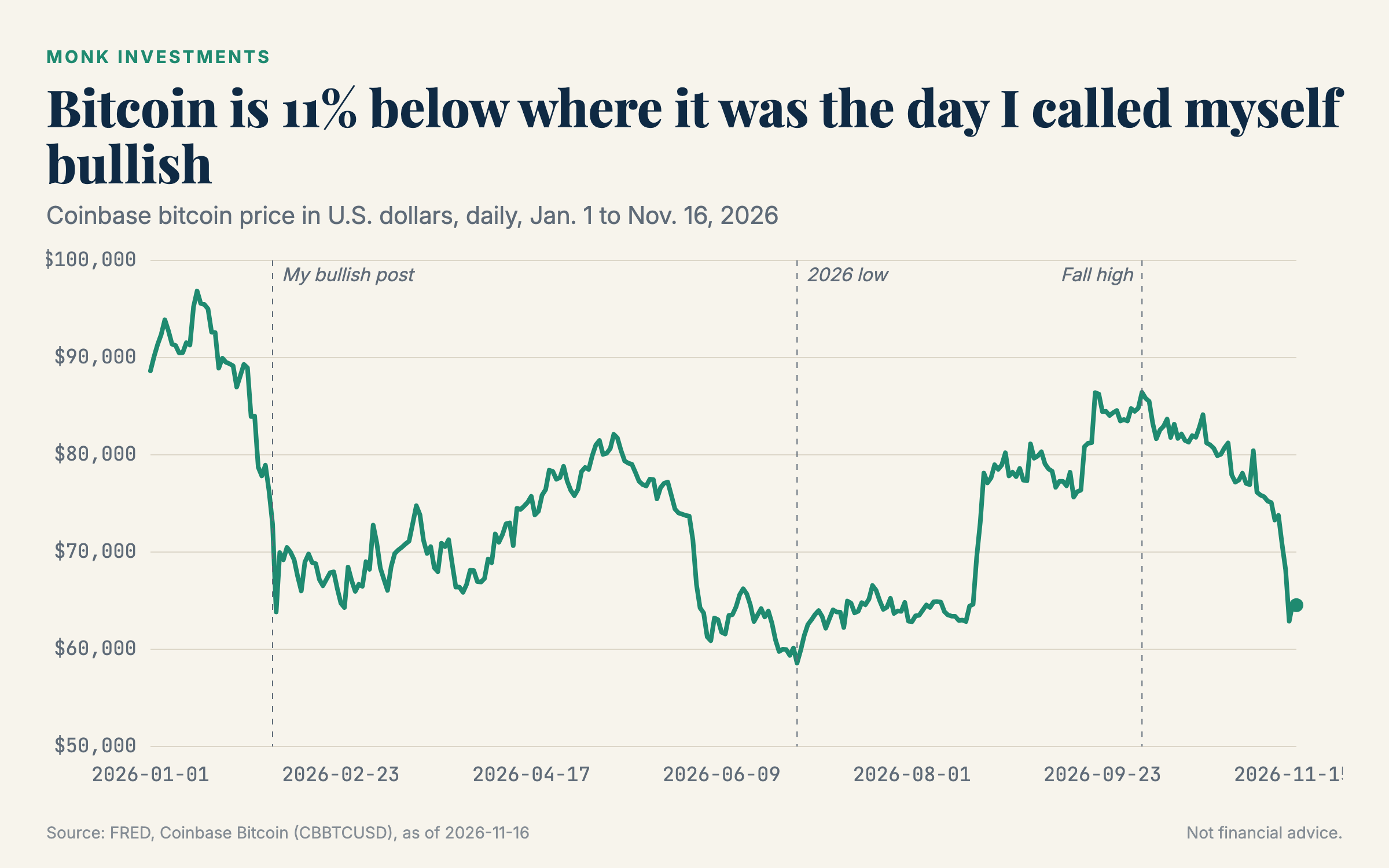
Here's mine. Back on Feb. 4, I published Why I'm Bullish on Bitcoin. Bitcoin closed that day at $72,854. By Monday it sat at $64,538 — 11% below the day I hit publish, and 25% below its Oct. 4 high.[1]
Most people in that spot do one of two things. They dig in and call it a dip, or they bail and call it a scam. Both skip the actual work.
The work is a thesis check: testing the reasons behind an investment, not the price. Is the price down? Obviously. The question is whether the reasons you believed still hold.
TL;DR — A falling price is a question, not an answer.
First, Why This Month Hurt
Over the weekend, bitcoin fell as low as $62,000, and it just logged its sixth losing week in a row.[2] The short version: traders who borrowed money to bet on bitcoin going up got forced to sell as the price fell, which pushed it lower, which forced more selling. Add a strong dollar, big investors pulling back from bitcoin ETFs (funds that trade like a stock), a tech selloff, and a $6.3 billion hack at the crypto exchange Binance, and you get six red weeks.[2]
None of that tells you whether bitcoin is a good long-term idea. It tells you why November felt the way it did.
Three Questions for a Red Week
Back in March, in Investments I Got Wrong and What They Taught Me, I turned my three worst losses into three questions. Two of them fit here. The third, about whether a company turns attention into revenue, is built for businesses, and bitcoin isn't one. So I'm swapping in a question for red weeks.
Is this my thesis? Could I defend it, with data, if someone challenged me?
Do I have a reason, or is it just cheaper? "Down a lot" describes the past. It isn't a reason.
Did something change, or does it just hurt? Selling because something broke and selling because it stings look identical on your trade history. They aren't.
Question 1: Is This Actually My Thesis?
I learned this one the hard way. I once overheard my grandpa and dad talking about Rio Tinto, which had gone up a lot for them. When I brought it up later, my grandpa said, "Don't buy it right now, it's too high." I dumped my piggy bank into it anyway — at the top, without even knowing it was a mining company. It fell about 15% within three months, and I panic sold. Boy, was it dumb.
Secondhand conviction is what makes you panic. So here's my February post, reread with one question: which parts can I still defend with data?
In February I wrote that bitcoin not moving in step with stocks was a strength. Here's the test. On Nov. 5, the Nasdaq, the tech-heavy stock index, fell 5.5%. Bitcoin fell 5.3% the same day. That wasn't a one-off. I lined up the Nasdaq's 10 worst days of 2026, and bitcoin fell on every single one.[3]
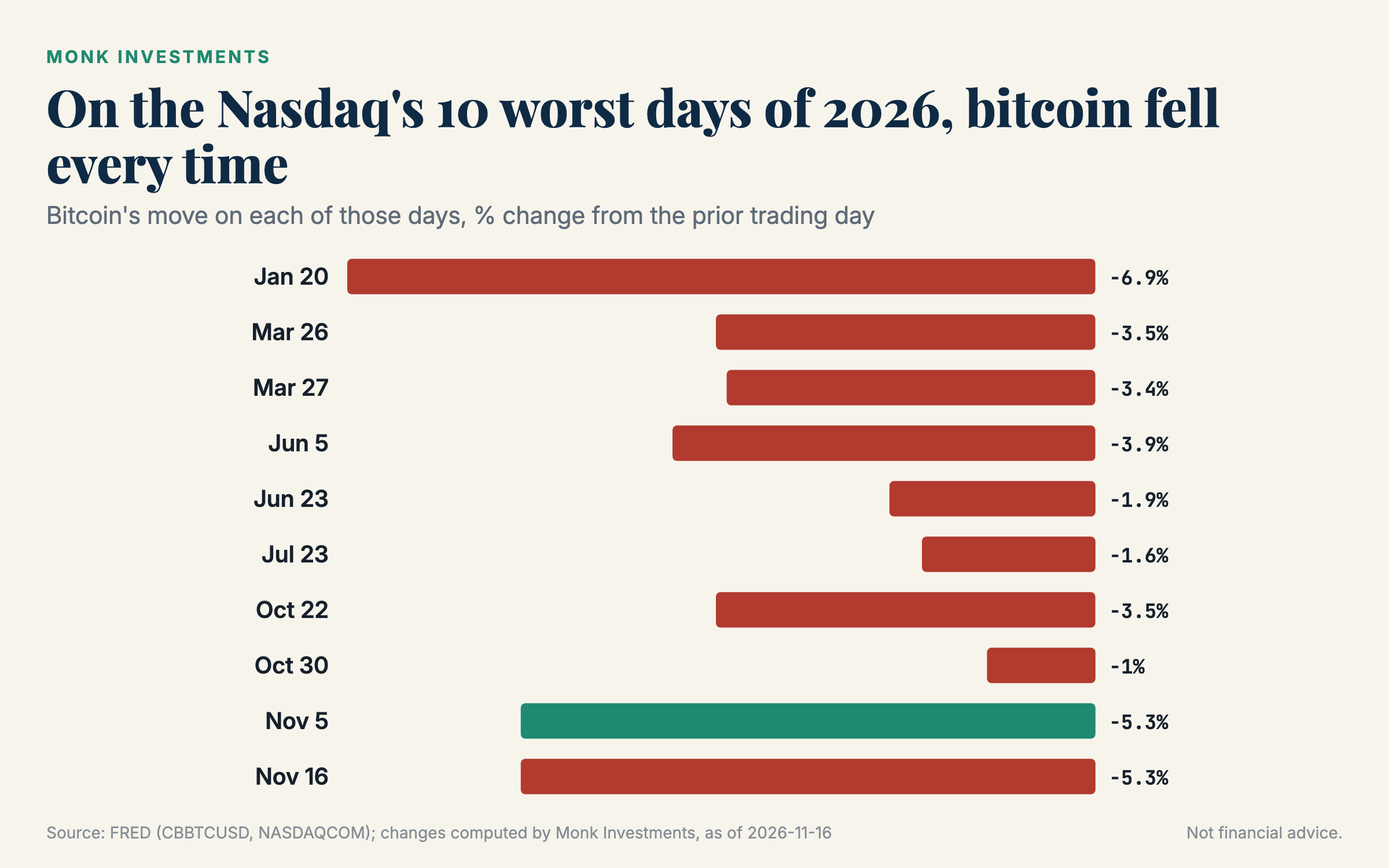
To be fair, over the whole year they've gone in opposite directions: the Nasdaq is up 5.5% in 2026, and bitcoin is down 26%.[3][1] But on the scary days, when you'd most want something that holds up, bitcoin acted like a tech stock with the volume turned up.
I also wrote that bitcoin hedges against inflation, meaning it should hold its value while prices for everything else rise. Consumer prices rose 3.7% in the year through September.[4] Bitcoin is down 26% this year.[1] And this isn't the first test. In 2022, inflation peaked near 9%,[4] and bitcoin lost 64% over the year.[5]
Two stretches is not a sample size, and "hedge" might mean over decades, not years. But I wrote it like it was settled. It isn't.
What still holds is the supply cap I leaned on: only 21 million bitcoins will ever be created.[6] Nothing in six weeks changed that. But scarcity puts a ceiling on supply. It doesn't put a floor under the price.
Question 2: A Reason, or Just a Discount?
Right now plenty of people are calling this a sale. Bitcoin is about 48% below its October 2025 record.[1] That sounds cheap.
I've been here too. I bought UnitedHealth after a sharp dip, believing a blue-chip was trading at half its worth. But earnings were slipping, so it wasn't just dipping — it was repricing. I refused to admit I was wrong, then cut the position out of anger. It later rallied past $350.
A price drop is like stepping on the scale the morning after Thanksgiving. It tells you something happened. It doesn't tell you whether you're healthy.
A real reason sounds like this: here's what I think the market is missing, and here's what I'd expect to see if I'm right. If you can't finish that sentence about bitcoin, or anything else you own, the discount doesn't matter.
Question 3: Did Something Change, or Does It Just Hurt?
This is the one that saves you from the panic sell. Make two lists. What changed: the price, a lot of borrowed money getting flushed out, big investors stepping back from the ETFs,[2] and in my case, two of my own reasons that didn't survive the data. What didn't change: the fixed supply, and the fact that nobody, me included, knows where the price goes next.
If the only thing on your "changed" list is the price, that's not a reason. That's a feeling. If real reasons are on it, take them seriously — even if it means admitting you were wrong.
Especially then.
To be clear, I'm not a licensed advisor, and this isn't a call to buy or sell bitcoin. It's a way to check your own reasons, whatever you decide.
Where I Could Be Wrong
This could age badly in either direction. If bitcoin climbs back past its fall high, my "it trades like a tech stock" point will look like nitpicking. If it breaks well below this year's low of $58,586 from June 30,[1] the people who always called it a bubble will feel vindicated. Neither outcome makes the check useless, because the check was never about price.
Keep the February Post Up
I'm not taking the February post down. It stays up, right next to this one, because that's the deal here: I publish the calls that age badly next to the ones that age well.
In Pro this week, I'm turning these three questions into a one-page thesis check and running it on one of my own past calls, start to finish, mistakes included.
Prices fall. That's their job. Your reasons are the part you're supposed to keep in shape, and the only way to know how they're doing is to step on the scale.
Your turn: what's one reason behind an investment you've never actually tested against the data? Tell me in the comments.
Until next time — let's keep the stock market simplified.